Applying the preparations
How and when the biodynamic preparations go onto soil, plants and compost: time of day, season, quantities and equipment.
The sowing days in your inbox once a month
The calendar mail brings the sowing days and all gardening sheets as PDFs every month. Free, unsubscribe with one click.
How are biodynamic preparations applied?
How they are applied depends on the type of preparation. The two groups, field spray preparations and compost preparations, are used in fundamentally different ways. In both cases, close observation of soil and plants is what matters: when a preparation is applied depends on the crop, the weather and the stage of growth, not on fixed dates.
Spray preparations: stir and spray
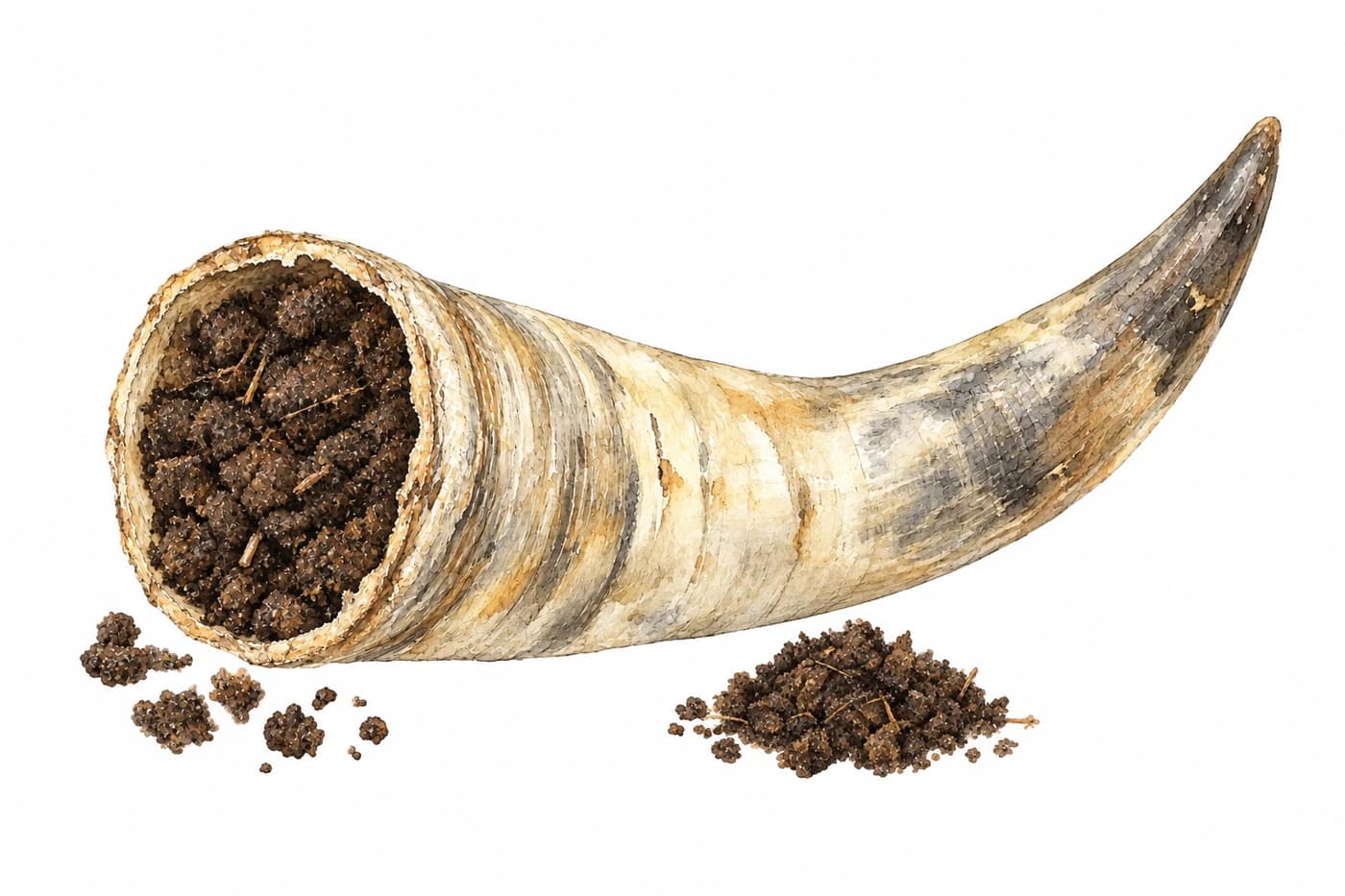
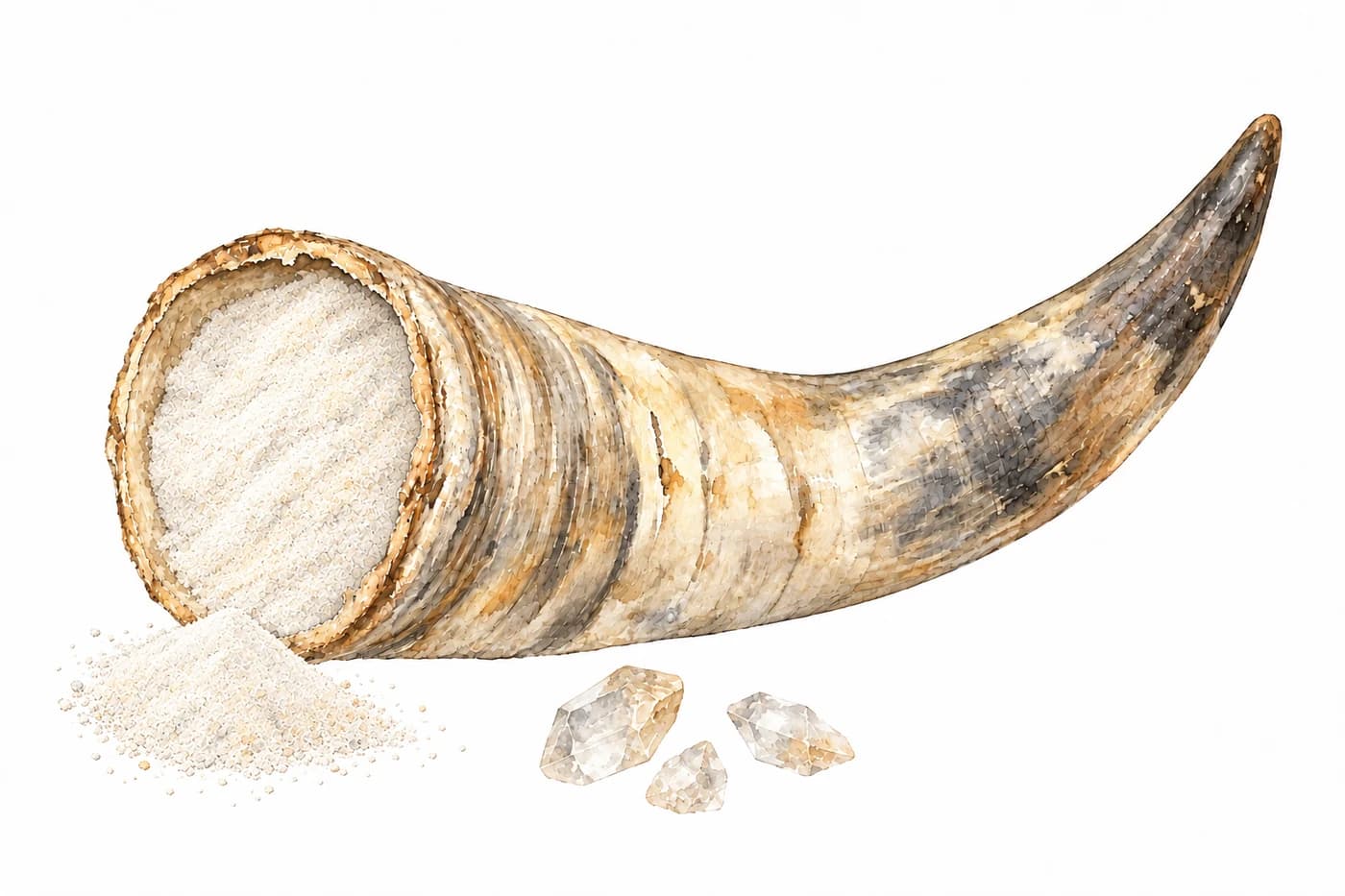
Horn manure 500 and horn silica 501 are stirred in water for an hour before use, the dynamisation. Then they are applied promptly, because the effect of the stirred preparation fades after about a day.
Two opposite rules of thumb apply, reflecting the character of the two preparations. Horn manure is sprayed in the evening (or afternoon) and onto the soil, in large drops, ideally onto soil that is freshly worked or about to be worked, when the forces are drawn into the earth. Horn silica is sprayed in the morning (preferably while the dew is still on) and onto the plant, as finely as possible, as soon as there is enough green leaf. Clear weather supports the effect; hot midday sun and drying or cold winds are avoided. As ripening begins, horn silica moves to the afternoon.
Timing through the year
Horn manure is applied mainly in spring and autumn: to prepare the soil before sowing and planting, on meadows, pastures and freshly mown land, on trunks and into tree crowns, and on all crops in prolonged drought. In early spring as early as possible, as soon as meadows and winter cereals can be walked or driven on; an old marker is St Peter's day (25 February), around which a change in the weather is often noticeable and the "inner life of the earth" reawakens. In autumn it is sprayed after harvest and before autumn sowing, often complemented by the cow pat preparation to guide decomposition.
Horn silica accompanies the growing plant: it can be used in autumn on well-developed winter cereals, in spring to encourage tillering, and rhythmically from the second or third leaf. Rhythmic sprayings have proved themselves for strengthening against fungi and insects: at the same time of day on three consecutive days (24 hours apart), repeated every two to three weeks. Repeated applications of horn silica are reported to increase yield, ripening, keeping quality and evenness of quality.
By crop: arable, grassland, garden, orchard and vineyard
Horn manure goes with the soil work, horn silica as soon as there is enough green leaf. This is how it looks in the individual crops, after Wistinghausen et al. and Masson:
Arable and cereals. Horn manure directly before or after sowing, in autumn for sowing winter cereals and catch crops, once more in spring, above all where the stand is weak, and for stubble cultivation and sowing green manure. Masson does not spray from a combined machine at the same time as sowing: the preparation and the soil work each need their own moment. Horn silica on well-developed winter cereals already in autumn, in spring from the two-leaf stage until stem extension, at ear formation and at grain formation, as long as the field can still be driven on. The cow pat preparation goes with ploughing, stubble cultivation and breaking up clover grass.
Meadows and pastures. Horn manure in early spring, as soon as the ground can be walked on, then after every cut and every grazing, above all after the last use in autumn, from mid-August when the soil is moist. Horn silica follows eight to ten days later, when the young shoots are about ten centimetres long; in drought it is postponed, at the latest to two weeks before the next use. The cow pat preparation comes after grazing and after cutting.
Vegetables and garden. Horn manure once over the whole area at the start of the year, then at the main sowing and planting dates; in a home garden on the day most of the beds are prepared for sowing, in autumn after clearing. Horn silica follows the sowings: lettuce and cabbage when they start to form heads, radishes when the roots begin to swell, root vegetables two to three weeks before harvest in the evening. Tomatoes, strawberries and cucurbits tolerate it even in flower. Freshly transplanted seedlings get it only once they have taken root.
Orchard and vineyard. Horn manure shortly before or right after leaf break, on soil, trunk and crown, not too early or the plants become more sensitive to frost; in autumn as soon as possible after harvest. Horn silica in the orchard before flowering on well-formed leaves, then on the small fruits, at ripening in the afternoon and after harvest for wood ripening, never into open blossom. In the vineyard one to three times from five unfolded leaves until flowering, more often in wet summers, and three weeks to eight days before the grape harvest. The cow pat preparation comes after a compost application, when chipping prunings and before leaf fall; in vineyards the variant made with horse manure has proved itself.
Quantities
Figures vary by region and author; the following ratios have proved themselves in Central Europe:
- Horn manure: one portion (the contents of one horn) in the water for 2,500 m², depending on moisture about 30 to 80 g in 10 to 15 l. Per hectare that means four horns' contents (≈ 120 to 300 g) in 40 to 60 l of water. On large areas with good equipment the amount can be reduced (in English-speaking countries often about one horn per hectare). At the end, 1 to 2 cm³ of valerian per hectare can be stirred in for the last few minutes; this strengthens the enlivening effect, especially in a cold spring and before frosty nights.
- Horn silica: one portion = 1 g in 10 to 15 l of water for 2,500 m², correspondingly 4 g in 40 to 60 l for one hectare of grassland and arable land; in orchards and soft-fruit plantings about 8 g.
To encourage root formation, the roots of plants can be dipped briefly into the stirred horn manure just before planting.
Compost preparations: working them in
The compost preparations (502 to 507) are not sprayed but worked into compost and farmyard manure: the five solid ones (502 to 506) as small lumps in holes made in the heap, the liquid valerian (507) diluted and sprayed or poured over it. One set is enough for about ten cubic metres of solid manure. They are added as soon as organic matter accumulates, and again after turning.
Technique and equipment
In a home garden, a bucket and a hand brush (for large drops of horn manure) or a fine sprayer (for the horn silica mist) are enough. In the field, knapsack sprayers or tractor-mounted sprayers are used; copper or enamelled vessels are suitable as tanks, while plastic and aluminium are avoided. The stirred preparation is sieved before spraying so that the nozzles do not clog. The horsetail decoction (508) is also sprayed, preventively against fungal pressure and often together with horn silica.
Frequently asked questions about applying the preparations
When are horn manure and horn silica sprayed?
Horn manure in the evening or afternoon onto the soil, horn silica in the morning onto the plants. Both after an hour of stirring and applied promptly.
How much preparation is needed per hectare?
Horn manure about 120 to 300 g (four horns' contents) in 40 to 60 l of water, horn silica about 4 g in 40 to 60 l (orchards and soft fruit about 8 g). Quantities vary with region and equipment.
What are the preparations applied with?
In a home garden with a bucket and brush or a hand sprayer, in the field with a knapsack sprayer or tractor-mounted sprayer; tanks of copper or enamel, not plastic or aluminium.
Are compost preparations sprayed too?
Usually not; they go into the compost as small lumps. The exception is the liquid valerian, which can also be sprayed.
How soon after stirring must it be sprayed?
As promptly as possible: the effect of the stirred preparation fades after about a day.
Can horn silica be sprayed into flowers?
Not on fruit trees, vines and most vegetables. Tomatoes, strawberries and cucurbits tolerate it because they flower continuously.
Buy and use biodynamic preparations
 Horn manure 500from €19.69View preparation →
 Horn silica 501from €14.19View preparation →
 Horsetail preparation 508from €14.19View preparation →
All biodynamic preparations →How much do I need? Open the preparation calculator →