Biodynamic preparations 500 to 508
The heart of biodynamic farming: nine preparations, numbered 500 to 508, applied to soil, compost and plants in very small, highly diluted amounts.
The sowing days in your inbox once a month
The calendar mail brings the sowing days and all gardening sheets as PDFs every month. Free, unsubscribe with one click.
What are biodynamic preparations?
Biodynamic preparations are the heart and the defining feature of biodynamic agriculture. They are a series of substances made from mineral, plant and animal materials according to fixed recipes and applied to soil, compost and plants in very small, highly diluted amounts.
The key to understanding them: the preparations are not fertilisers in the usual sense. They supply no significant amounts of nutrients; a few hundred grams or even just a few grams are enough for a hectare. Rather, they are meant to guide and order processes: to enliven the soil, steer the decomposition of compost and promote the ripening of the plant. In biodynamic language they are "material bearers" of forces, a means of bringing quality rather than mass into the farm. The researcher Hartmut Spiess summed up the scientific view by saying that the preparations act as a kind of system regulation: balancing, normalising, promoting equilibrium.
Eight plus one: the nine preparations
The canon comprises nine preparations numbered 500 to 508, which fall into three groups.
The two field spray preparations are stirred in water and sprayed. Horn manure 500 (500), made from cow manure in a cow horn, works through soil and roots. Horn silica 501 (501), made from quartz in a cow horn, works through light and ripening. They are opposite poles: one "pushes up from below", the other "draws from above".
The six compost preparations (502 to 507) are worked into compost and farmyard manure and steer decomposition: yarrow (502), chamomile (503), stinging nettle (504), oak bark (505), dandelion (506) and valerian (507). They work together as a whole and are usually applied together.
Then there is horsetail 508 (508), which is sprayed as a tea or decoction against fungal pressure. It has a special place and is not, strictly speaking, a "preparation" but a plant care remedy; hence the phrase "eight or nine" preparations.
How the work is divided
As early as 1938, Ehrenfried Pfeiffer described from his trials how the preparations work together: "Preparation 500 acts especially on the growth of the roots and causes the formation of numerous root hairs. Preparation 501 increases the capacity for assimilation. Preparations 502 to 507 strengthen the plants in their growth, with 504 influencing flavour in particular and the others more the yield." Elstrup Rasmussen's image is also vivid: horn manure expands, horn silica contracts, and the compost preparations regulate the metabolism in between.
Origin and context
All the preparations go back to Rudolf Steiner and his Agriculture Course (GA 327) of 1924. There Steiner gave the recipes and his reasoning; he expressly meant them as a stimulus for independent research, not as a rigid recipe. The first preparations were made during his lifetime: Ehrenfried Pfeiffer took part in making the first batch of horn manure together with Ita Wegman and Günther Wachsmuth. The detailed practice of making and using them that still applies today was worked out by later authors, above all Eckard von Wistinghausen, Pierre Masson and Walter Stappung.
How do the biodynamic preparations work?
This is the most debated question about the method, and an honest answer distinguishes three levels.
The biodynamic view
In Steiner's understanding, the preparations are "material bearers of spiritual forces", a bridge through which ordering forces from the web of nature can act in soil and plant. The Demeter standards say that the preparations open soil, plant and animal "to cosmic and spiritual forces". Nikolai Fuchs aptly calls them "constitutional remedies" for the farm organism: they do not fight symptoms but strengthen soil and plant from within.
What research can grasp
Literature reviews (for example Scheper, Raupp and Baars 2009) suggest that horn manure and horn silica contain hormone-like substances that can influence plants and soil life. Several authors (for example Carpenter-Boggs) describe an effect as a microbial "inoculation": the preparations introduce and stimulate certain soil microorganisms. In the Darmstadt long-term fertilisation trial, preparations together with composted manure demonstrably increased the humus content and biological activity of the soil (Raupp).
The effect on the whole
What is characteristic is that the effect can rarely be pinned to a single measured value. It shows up as an optimisation of the whole system and depends strongly on site, climate, weather and management (Spiess). The eight or nine preparations are meant to work together and get the whole farm "moving"; they can be used individually, but they work best as an ensemble.
Preparations and fertilising
A common misunderstanding: the preparations do not replace fertilising. Steiner called them an "extra manuring" that "considerably enhances" the usual manuring with farmyard manure, slurry and compost; it does not replace it. The idea behind this is that good manuring is above all "enlivening the earth": the soil should become alive so that the plant does not root in "dead earth". The preparations set this liveliness in motion; the nutrient cycle continues to be carried by the compost and manure management of the farm organism.
Preparations and food quality
For the biodynamic movement, the quality of food was the real goal from the start, not maximum yield. Steiner saw the danger that crops might look splendid but be "merely stomach-filling" and no longer nourish the "inner being" of people. Several studies support the view that biodynamic produce does well here: in a study on lettuce (Heimler et al. 2013), the levels of valuable compounds (antioxidants) were highest in biodynamic produce, higher than in organic and conventional produce. Better keeping quality, less nitrate and more pronounced flavour are frequently reported. These comparisons usually concern the whole system; isolating the specific contribution of the preparations cleanly is methodologically difficult.
Biodynamic preparations and Demeter
For Demeter farms the preparations are not optional but a defined and binding practice. Horn manure must be applied at least once a year on all land, horn silica in a way suited to the crop, and the compost preparations belong in all organic farmyard manures. It is precisely this obligation that distinguishes Demeter from all other organic associations (see Demeter certification).
What long-term trials show
The DOK long-term trial of the Research Institute of Organic Agriculture (FiBL) has compared biodynamic, bio-organic and conventional farming in Therwil, Switzerland, since 1978. For the biodynamic system it shows high soil fertility, with higher humus content and clearly increased activity of soil organisms.
Making the preparations through the year
The preparations follow the course of the year: flowers in summer, sheaths and pits in autumn, digging up in spring. The circle shows what is due when.
- 1
Feb – Mar502503506500505
Dig up last year’s yarrow, chamomile, dandelion, horn manure and oak bark, prepare and store them.
- 2
Mar – Apr502
Stuff yarrow into the stag’s bladder and hang it up in a sunny, airy place.
- 3
Mar – Apr503
Stuff the chamomile and hang it up in an airy place.
- 4
Apr – May501
Fill horn silica into the horns and bury them over the summer.
- 5
Apr – May506
Pick dandelion flowers, wrap them and hang them up in an airy place.
- 6
May – Jun504
Dig up last year’s stinging nettle and store it; mow fresh plants for the new preparation and bury them.
- 7
Jun503
Pick chamomile flowers and dry them.
- 8
Jun507
Pick valerian flowers, press them and bottle the juice.
- 9
Jun – Jul508
Collect field horsetail and dry it for the tea.
- 10
Jul502
Pick yarrow flowers and dry them.
- 11
Jul – Aug507
Check the valerian preparation, sieve it finely and store it. Get the sheaths: horns, stag’s bladders, skulls, mesentery, intestines.
- 12
Aug – Oct505
Collect oak bark, grate it, stuff it into the skull of a domestic animal and bury it in a wet spot.
- 13
Sep – Nov500502503506501
From Michaelmas: fill cow manure into horns and bury them, take down the yarrow and bury it, bury chamomile in small intestine and dandelion in mesentery, dig up horn silica.
- 14
Dec – Jan501
Grind quartz finely for the next horn silica.
Sources
Compiled from knowledge graphic no. 9 in Lebendige Erde (3/2020).
Frequently asked questions about biodynamic preparations
How many biodynamic preparations are there?
Nine, numbered 500 to 508: two spray preparations (500, 501), six compost preparations (502 to 507) and field horsetail (508), which has a special role.
What is the difference between spray and compost preparations?
Spray preparations (500, 501) are stirred in water and sprayed onto soil or plants. Compost preparations (502 to 507) are worked into compost and farmyard manure, where they steer decomposition.
Do the preparations replace fertiliser?
No. They are an "extra manuring" that complements and enlivens normal manuring with farmyard manure and compost; they do not replace it.
How do the preparations work?
In the biodynamic understanding, as force-giving "constitutional remedies"; scientifically, hormone-like substances and a microbial inoculation effect are discussed.
Are the preparations compulsory for Demeter?
Yes. Making and using them is a binding biodynamic practice and required of every Demeter farm.
Buy and use biodynamic preparations
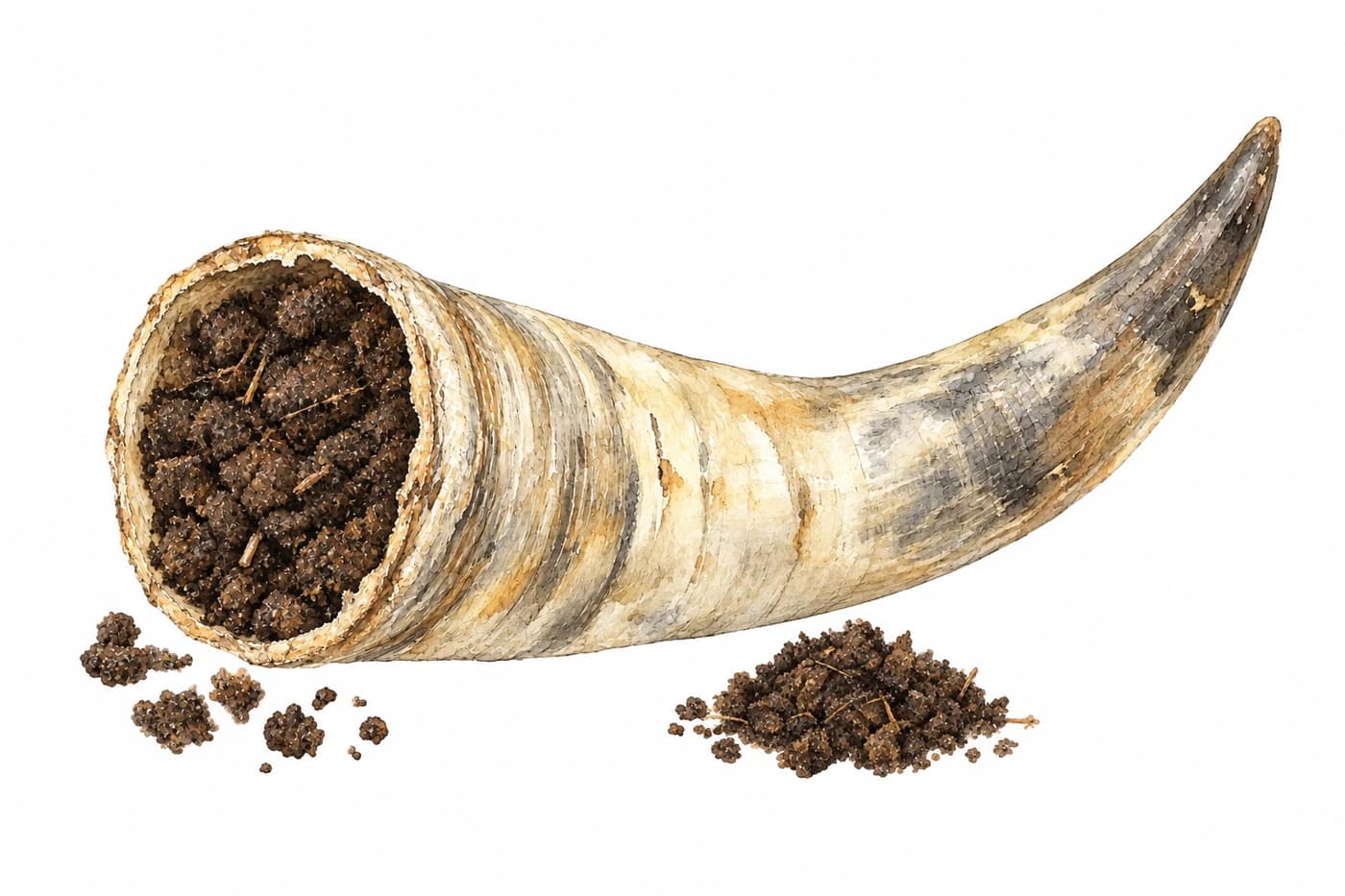 Horn manure 500from €19.69View preparation →
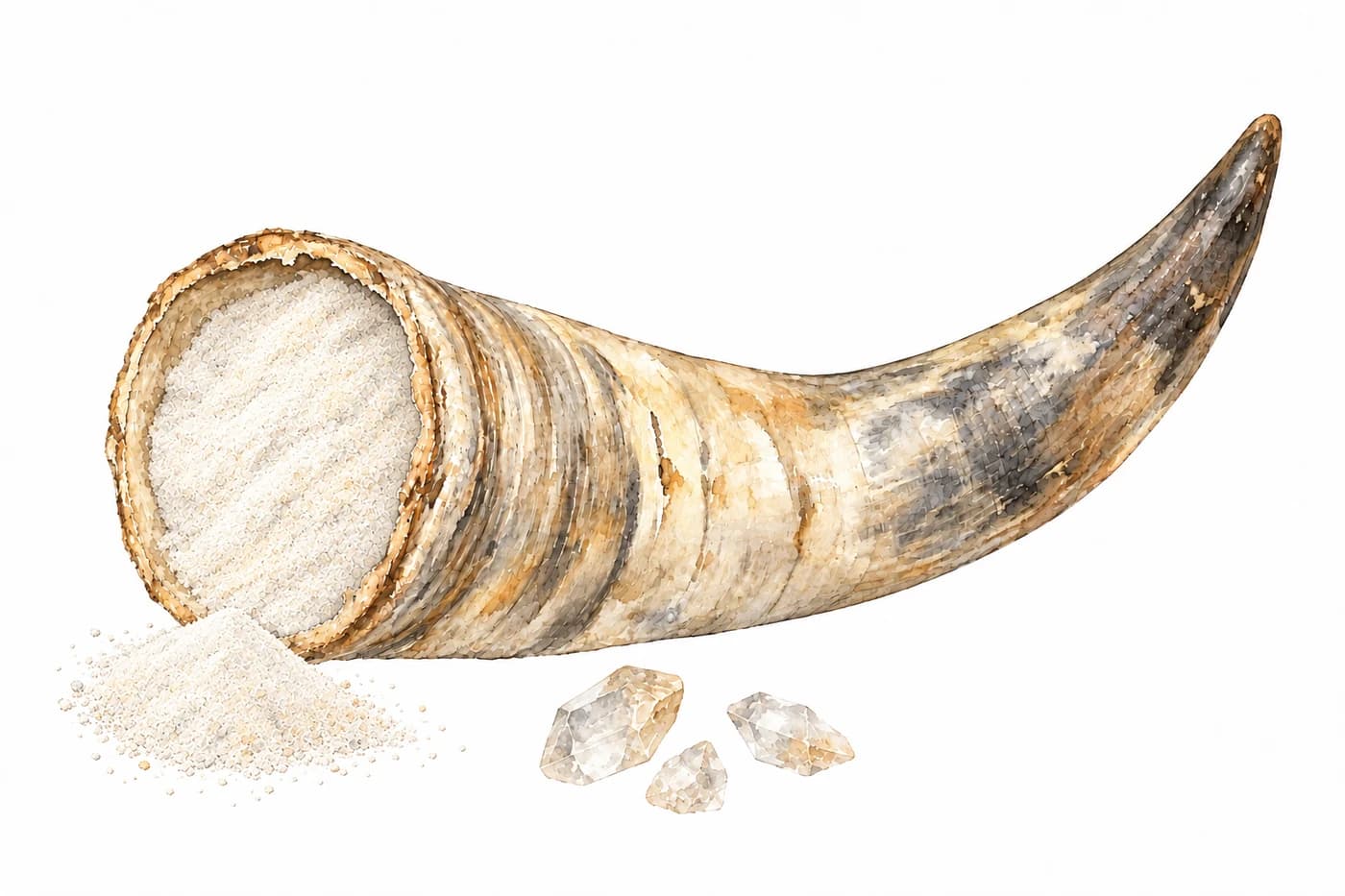 Horn silica 501from €14.19View preparation →
 Horsetail preparation 508from €14.19View preparation →
All biodynamic preparations →How much do I need? Open the preparation calculator →