Agriculture Course
The Agriculture Course (GA 327) is the series of lectures Rudolf Steiner gave at Koberwitz in 1924: eight lectures that form the founding text of biodynamic agriculture.
The sowing days in your inbox once a month
The calendar mail brings the sowing days and all gardening sheets as PDFs every month. Free, unsubscribe with one click.
What is the Agriculture Course?
The Agriculture Course is the series of lectures with which Rudolf Steiner founded biodynamic agriculture in 1924. In the collected edition of his works it has the number GA 327; its full German title is "Geisteswissenschaftliche Grundlagen zum Gedeihen der Landwirtschaft" (spiritual-scientific foundations for the flourishing of agriculture). It is the original text to which the whole biodynamic method and its specialist literature go back. Every later work, from Wistinghausen and Maria Thun to Masson, builds on it.
How it came about at Koberwitz
Steiner gave the course at Whitsun 1924 at Koberwitz, the estate of the Keyserlingk family in what was then Silesia (today Kobierzyce, Poland). His audience numbered around a hundred, mostly farmers, estate owners and scientists. The occasion was concrete: with the spread of mineral fertilisers, many farmers had seen soil fertility, seed, plant health and animal health decline, and they asked Steiner for advice. The course consists of eight lectures, together with question-and-answer sessions and an address. It was Steiner's last major lecture cycle; he died the following year.
What the eight lectures cover
The course develops a coherent picture that moves from the large scale to practice.
The first lectures lay the foundations: the interplay of earthly and cosmic forces, and the soil seen as part of a living natural process. In the second lecture, Steiner sets out the guiding image of the farm organism: the farm as "a self-contained individuality". Later lectures deal with the role of substances (nitrogen, lime, silica and others) in plant growth.
In the fourth lecture, Steiner describes the two horn preparations: horn manure 500 (cow manure in a cow horn) and horn silica 501 (quartz in a cow horn), how they are made, stirred and applied. The fifth lecture is devoted to the compost preparations (yarrow, chamomile, stinging nettle, oak bark, dandelion and valerian) and their task of bringing the manure to life. Further lectures cover plant diseases and "pests", the interaction of plants and animals, and the character of the farm.
Significance
The course is not an agricultural handbook in the usual sense but a set of suggestions grounded in spiritual science. Steiner gave images, connections and recipes, but saw them as a starting point for people's own trials, not as finished instructions. That is exactly why decades of practical work were needed after him before today's preparation practice had been worked out. Anyone who wants to follow the course in detail therefore also turns to the later works that build on it (Wistinghausen, Masson, Stappung).
Context
The Agriculture Course is Steiner's spiritual-scientific view of agriculture. As such it is the key text that biodynamics still takes its bearings from today, and the text its critics take aim at.
Koberwitz 1924: the eight lectures
From 7 to 16 June 1924 Rudolf Steiner spoke to farmers at the Koberwitz estate. The core of each lecture in one sentence:
June 7 1924 · Lecture 1
The Earth in the cosmos
The Earth is bound into the working of Sun, Moon, planets and stars; their rhythms shape all that lives.
More on this lecture
- Agriculture includes not only the soil but its surroundings out into the cosmos. Plants are connected with the planets.
- Through silica and warmth, the planets far from the Sun, Saturn, Jupiter and Mars, act on the nourishing power of plants.
- Through lime and water, the planets near the Sun, Moon, Venus and Mercury, act on their power to reproduce.
- Life frees itself from cosmic rhythms step by step: the plant least, the animal more, the human being most.
- Thinking of farming as a machine produces food without inner nourishing power.
June 10 1924 · Lecture 2
The farm as an individuality
A healthy farm largely produces its own inputs and is run like a closed organism.
More on this lecture
- Silica, lime, clay and humus form the basis of the farm organism.
- Silica draws the cosmic into the soil, clay carries it upward in the plant, lime helps the soil to digest the earthly.
- The animals provide the manure. How many horses, cows and pigs a farm keeps determines the mix in the manure.
- The soil acts like an organ of the farm, comparable to the human diaphragm.
- In the plant the earthly shows in the shape and thickness of the leaves. In the green it joins with the Sun, and in the flower colour the distant planets are at work.
June 11 1924 · Lecture 3
The substances of life
Nitrogen, carbon, oxygen, hydrogen and sulphur carry life; the plant takes hold of them with silica and lime in the soil.
More on this lecture
- Sulphur, carbon, oxygen, nitrogen and hydrogen build up protein. Lime and silica accompany them.
- Each of these substances carries a principle: carbon form, oxygen life, nitrogen sensation. Sulphur brings the spiritual into matter, hydrogen dissolves matter again.
- On Earth the spiritual always needs a physical carrier.
- When nitrogen enters the earth, it gives the soil a kind of sensitive life.
- In the soil, silica stands for the outer sense and lime for desire. Clay mediates between the two.
June 12 1924 · Lecture 4
Soil and plant
Manuring means enlivening the earth and strengthening the plant, for instance with horn manure and horn silica.
More on this lecture
- Steiner introduces horn manure and horn silica and so widens the idea of manuring.
- Horn manure supports a healthy soil and a strong root.
- Horn silica brings in light and supports quality in leaf, flower and fruit.
- There is no sharp boundary between the life in the plant and the life in the soil around it.
- Steiner looks at compost and humus formation through the image of the tree. Working with manure calls for a personal relationship to it.
June 13 1924 · Lecture 5
The compost preparations
Medicinal plants such as yarrow and dandelion, prepared in animal sheaths, give manure and compost living forces.
More on this lecture
- Steiner introduces the six compost preparations: yarrow 502, chamomile 503, stinging nettle 504, oak bark 505, dandelion 506 and valerian 507.
- The plants go into animal sheaths and mature in the soil over the course of the year.
- In tiny amounts they go into compost, manure or slurry and work there and in the manured soil.
- Against the depletion of the earth’s forces they act like a remedy.
- The graphic assigns a substance to each preparation: yarrow potassium, chamomile calcium and potassium, nettle iron, oak bark calcium, dandelion silica, valerian phosphorus.
June 14 1924 · Lecture 6
Weeds and pests
Moon and Sun act through the soil on growth and reproduction; this helps to regulate weeds and pests.
June 15 1924 · Lecture 7
Farm and landscape
Woods, hedges, fruit trees, meadows and wetlands keep the farm healthy; earthworms and insects enliven it.
More on this lecture
- Farming shapes the landscape: birds need conifers, mammals shrubs, insects broadleaved trees.
- A farm is healthy when the giving of the plants and the taking of the animals are in balance.
- Trees gather the astral. Their growth starts from the cambium layer.
- Small wetlands and damp areas keep fungal diseases and parasites away from the farm.
- Earthworms regulate life in the soil. A farmer should also understand something about insects and birds.
June 16 1924 · Lecture 8
Feeding
In nutrition, forces count for more than substances; animals need light, movement and strengthening feed.
More on this lecture
- Roots as food act above all in the head. Calves are therefore given carrots as well.
- Dairy cattle eat mainly leaf, especially clover and lucerne. For fattening, flowers and seeds are added.
- Manure carries forces that help the plant grow downward with gravity. This makes the place something of its own.
- Animals belong on pasture, where they perceive their surroundings, not in dark stables.
- The course ends with the cycle of substances on the farm, which develops into an individuality.
Sources
Rudolf Steiner: Geisteswissenschaftliche Grundlagen zum Gedeihen der Landwirtschaft (Agriculture Course), GA 327, Rudolf Steiner Verlag, Dornach.
Compiled from knowledge graphic no. 30 in Lebendige Erde (6/2023).
Compiled from knowledge graphics nos. 31 to 38 in Lebendige Erde (2024/2025).
Frequently asked questions about the Agriculture Course
What is GA 327?
The number of the Agriculture Course in the collected edition of Rudolf Steiner's works. Its full German title is "Geisteswissenschaftliche Grundlagen zum Gedeihen der Landwirtschaft".
When and where was the Agriculture Course given?
At Whitsun 1924 at Koberwitz estate (Silesia), in eight lectures to an audience of around a hundred.
What is in the Agriculture Course?
The foundations of biodynamics: cosmic and earthly forces, the farm organism, how the preparations (horn manure, horn silica, compost preparations) are made and what they do, and plant and animal health.
Is the course a practical guide?
Only in part. Steiner gave recipes and connections as suggestions; the detailed practice was worked out by his successors.
Buy and use biodynamic preparations
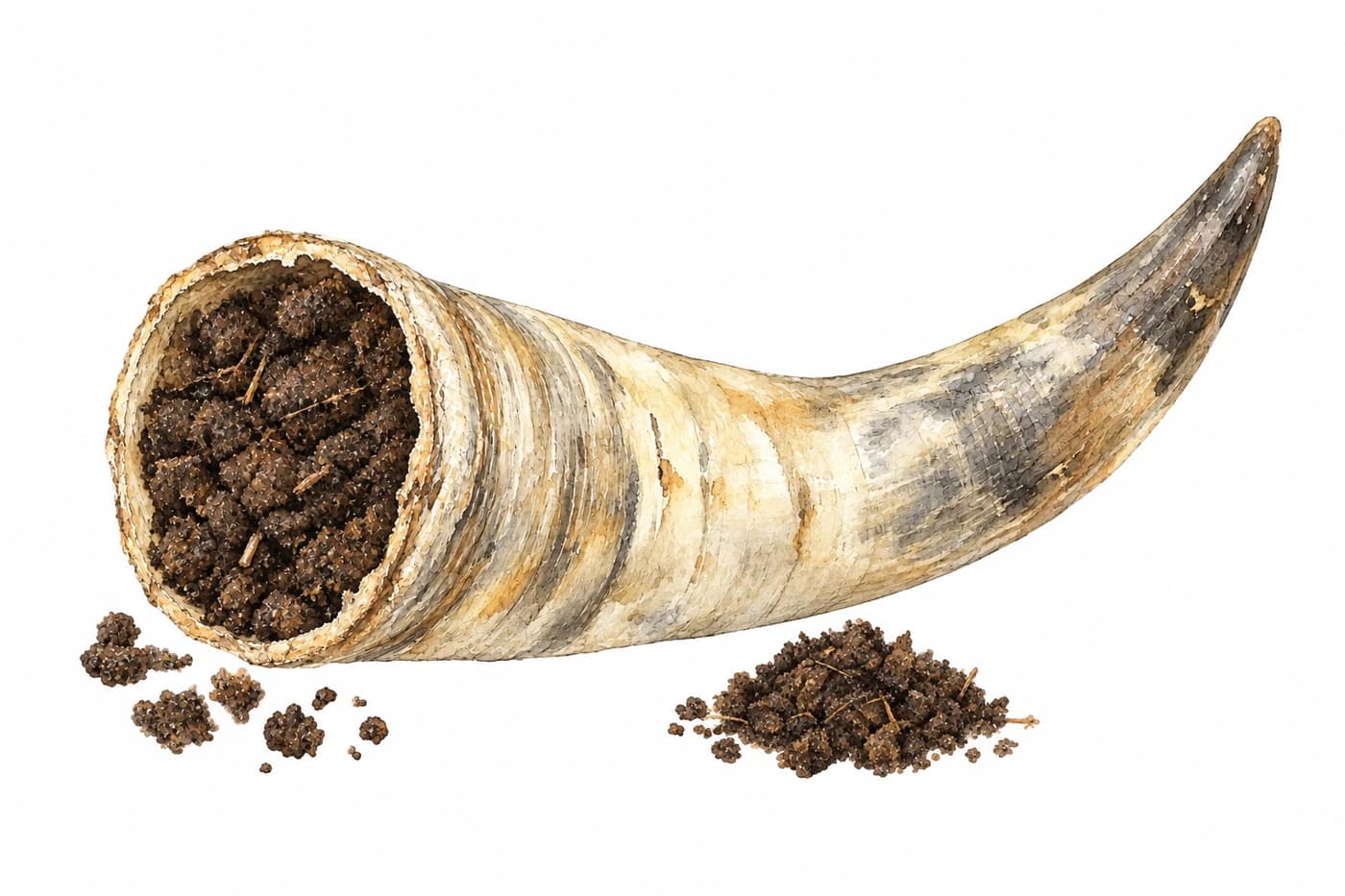 Horn manure 500from €19.69View preparation →
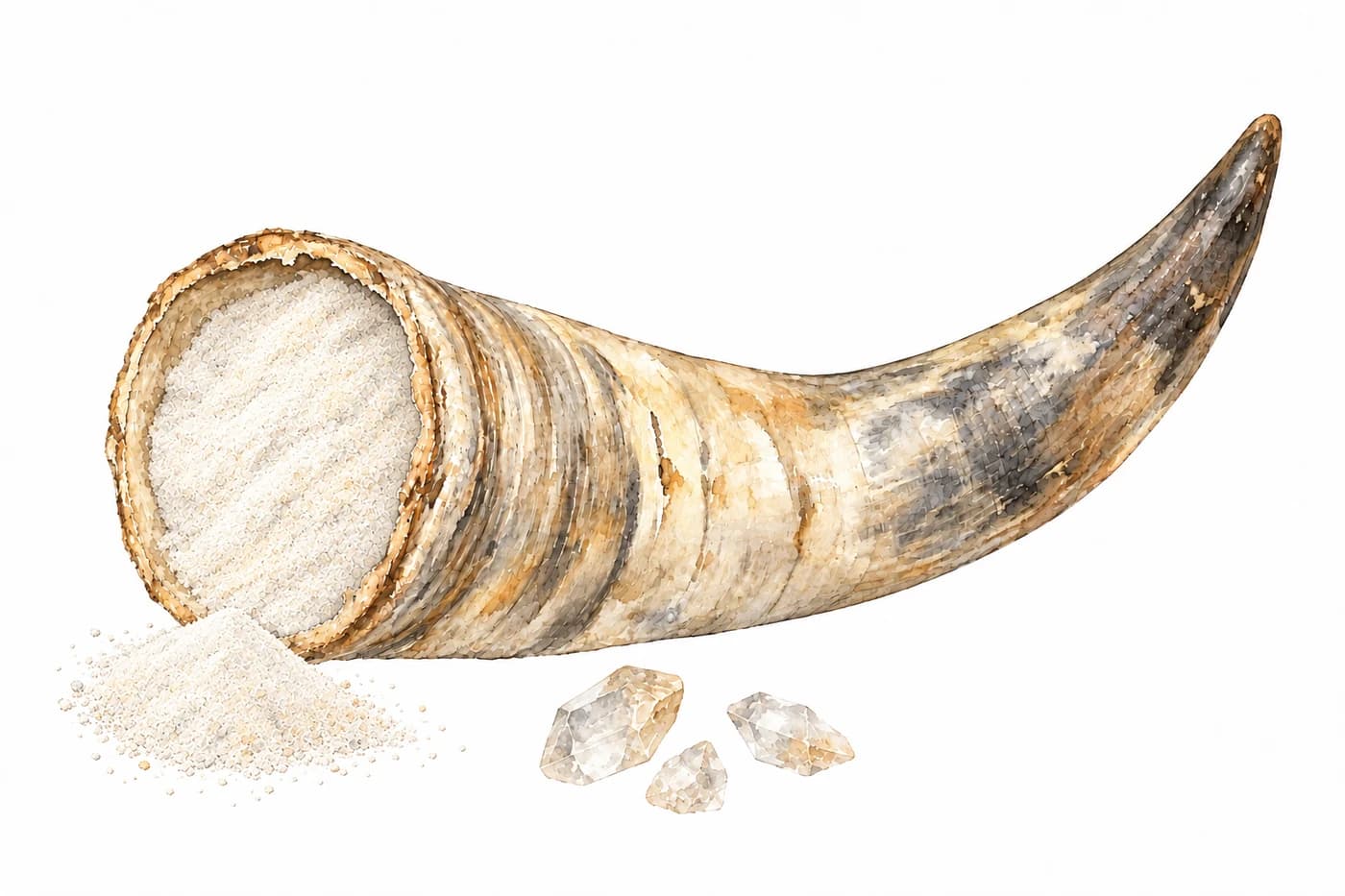 Horn silica 501from €14.19View preparation →
 Horsetail preparation 508from €14.19View preparation →
All biodynamic preparations →How much do I need? Open the preparation calculator →