Biodynamics and science
How scientific is biodynamics? An honest look at the evidence, the DOK long-term trial and the charge of esotericism, between proven benefits of the system and disputed assumptions.
The sowing days in your inbox once a month
The calendar mail brings the sowing days and all gardening sheets as PDFs every month. Free, unsubscribe with one click.
Is biodynamic agriculture scientific?
The question cannot be answered with a simple yes or no; it calls for a distinction. Biodynamic agriculture combines two levels: a concrete farming system (a closed cycle, compost management, no synthetic inputs, livestock) and a philosophical superstructure drawn from Steiner's spiritual science (cosmic forces, formative forces). The two levels can be tested to very different degrees, and this is where most misunderstandings arise.
What research shows about the system
For the farming system as a whole, there is solid data. The most important evidence is the DOK long-term trial of the Research Institute of Organic Agriculture (FiBL): since 1978, in Therwil, Switzerland, it has compared biodynamic (D), bio-organic (O) and conventional (K) farming on the same field, the most important long-term field trial of its kind worldwide. The biodynamic system comes out best for soil fertility and humus build-up: higher humus levels, markedly greater activity and diversity of soil organisms and a more stable soil structure, at around 85 percent of the conventional yield and with considerably lower inputs. The Darmstadt long-term fertilisation trial also found that preparations and composted manure increase the humus content and biological activity of the soil.
So the idea that a closed cycle with good compost management benefits the soil is not just a conviction; it can be measured.
What research suggests about the preparations
The isolated effect of the individual preparations, which are used in extreme dilution, is harder to pin down. There are indications, but no complete chain of evidence. Literature reviews describe hormone-like substances in horn manure and horn silica and an effect as a microbial "inoculation"; individual trials (such as the classic eosin trial on horn silica) point to effects. Researchers such as Hartmut Spiess describe the effect as "system regulation": balancing, hard to pin to a single measurement, and strongly dependent on site and farm management.
Food quality
Several studies suggest that biodynamically produced food does well on quality: for example higher levels of antioxidants (in one lettuce study, biodynamic came ahead of organic, which came ahead of conventional), better keeping quality and less nitrate. These comparisons mostly concern the system as a whole; cleanly isolating the specific contribution of the preparations remains methodologically difficult.
The charge of esotericism
Critics call biodynamics esoteric because of its anthroposophical basis. That is accurate insofar as central justifications really do come from a spiritual-scientific worldview rather than from empirical research: the "cosmic forces", the role of the cow horn and the stag's bladder, the effects of the zodiac cannot be derived from natural science. Conversely, it would be dishonest to conclude that the whole system has no effect: the benefits of the system for soil fertility and humus are proven.
An honest approach therefore separates what can be proven from what is a matter of worldview, instead of condemning or glorifying across the board.
What long-term trials measure in the soil
For decades two field trials have compared biodynamic, organic and conventional farming, with the same amount of fertiliser and the same rotation. Conventional is 100% here.
- Biodynamic
- 157 %
- Organic
- 103 %
- Conventional
- 100 %
- Biodynamic
- 161 %
- Organic
- 143 %
- Conventional
- 100 %
- Biodynamic
- 57 %
- Organic
- 79 %
- Conventional
- 100 %
- Biodynamic
- 140 %
- Organic
- 130 %
- Conventional
- 100 %
- Biodynamic
- 133 %
- Organic
- 140 %
- Conventional
- 100 %
- Biodynamic
- 125 %
- Organic
- 104 %
- Conventional
- 100 %
Sources
Figures from the knowledge graphic “Biodynamics connects soil and plant” in Lebendige Erde (4/2020).
- Bachinger J (1996): Der Einfluss unterschiedlicher Düngungsarten (mineralisch, organisch, biologisch-dynamisch) auf die zeitliche Dynamik und räumliche Verteilung von bodenchemischen und -mikrobiologischen Parametern der C- und N-Dynamik sowie auf das Pflanzen- und Wurzelwachstum von Winterroggen. Schriftenreihe des Forschungsring/IBDF Bd. 7.
- Mäder P, Edenhofer S, Boller T, Wiemken A, Niggli U (2000): Arbuscular mycorrhizae in a long term field trial comparing low input (organic, biological) and high input (conventional) farming systems in a crop rotation. Biol. Fertil. Soils 31: 150–156.
- Minarsch E M, Gattinger A, Skinner C, Mäder P (2020): Potenziale des Ökolandbaus in Zeiten des Klimawandels: Geringere Lachgas-Emissionen vor allem auf biodynamischen Ackerböden. Lebendige Erde 2/2020, 40–45.
- Pfiffner L, Mäder P (1997): Effects of Biodynamic, Organic and Conventional Production Systems on Earthworm Populations. Biol. Agric. Hortic. 15: 3–10.
- Raupp J (2001): Wirkungen der biologisch-dynamischen Präparate im Langzeit-Düngungsversuch. Lebendige Erde 5/2001, 42–44.
- Siegrist S, Schaub D, Pfiffner L, Mäder P (1998): Does organic agriculture reduce soil erodibility? The results of a long-term field study on loess in Switzerland. Agric. Ecosyst. Environ. 69: 253 ff.
How research measures food quality
Beyond the usual analysis of ingredients, biodynamic research has developed its own methods to compare food from different farming systems. Seven examples.
ObservationGrows differentlyBiodynamic grape bunches are looser and get sour rot less often than organic or conventional ones.
Storage testKeeps longerCarrots grown with all the preparations lost the least in storage.
Stress testHeals fasterSliced biodynamic cucumbers grew back together better and stayed green longer.
Laboratory analysisMore vitamin C, less nitrateSo with biodynamic spinach compared to conventional; beetroot was also sweeter.
Picture-forming methodAges more slowlyBiodynamic grape juice showed the least ageing in copper chloride crystallisation.
Sensory effect testFeels betterIn blind tastings Demeter bananas triggered more pleasant feelings.
Feeding trialMore fertileRabbits fed biodynamically were more fertile in the second and third generation.
Sources
Compiled from the knowledge graphic “Biodynamic food quality” in Lebendige Erde (4/2026).
- Meissner G. (2015): Untersuchungen zu verschiedenen Bewirtschaftungssystemen im Weinbau unter besonderer Berücksichtigung der biologisch-dynamischen Wirtschaftsweise und des Einsatzes der biologisch-dynamischen Präparate. Diss., Geisenheim.
- Wistinghausen E. v. (1979): Was ist Qualität? Wie entsteht sie und wie ist sie nachzuweisen? Versuche zur Qualitätsfindung im Feldgemüsebau. Schriftenreihe Lebendige Erde, Darmstadt.
- Doesburg-van Kleffens et al. (2025): Effects of cultivation systems on the antimicrobial, colour retainment and slice healing properties of consumer ready market samples of cucumber. Applied Food Research 5 (1), 100754. DOI
- Elsaidi S. M. (1982): Das Nachernteverhalten von Gemüse, insbesondere Spinat. Diss., Gießen; Bavec M., Turinek M. et al. (2010): Influence of Industrial and Alternative Farming Systems on Contents of Sugars, Organic Acids, Total Phenolic Content, and the Antioxidant Activity of Red Beet. J. Agric. Food Chem. 58, 11825 ff. DOI
- Fritz J. et al. (2017): Quality characterisation via image forming methods differentiates grape juice produced from integrated, organic or biodynamic vineyards in the first year after conversion. Biol. Agric. Hortic. 33, 195–213. DOI
- Geier U. (2021, 2024): Wirksensorische Profilierung von Bananen. Unveröffentlichter Untersuchungsbericht für die Biodynamic Federation – Demeter International.
- Staiger D. (1986): Einfluss konventionell und biologisch-dynamisch angebauten Futters auf Fruchtbarkeit, allgemeinen Gesundheitszustand und Fleischqualität bei Hauskaninchen. Diss., Bonn.
Frequently asked questions
Is Demeter esoteric?
The biodynamic method has esoteric, anthroposophical origins. At the same time, the farming system shows measurable benefits for soil fertility. Both belong in an honest answer; one does not rule out the other.
Are there studies on biodynamics?
Yes, the best known being FiBL's DOK long-term trial (since 1978). It shows benefits of the biodynamic system for soil and humus. The effect of individual preparations, on the other hand, remains scientifically disputed.
Does biodynamics "really" work?
As a farming system for soil fertility and product quality, there is good evidence for it. The specific effect of the individual preparations in high dilution, on the other hand, has not been conclusively proven.
Buy and use biodynamic preparations
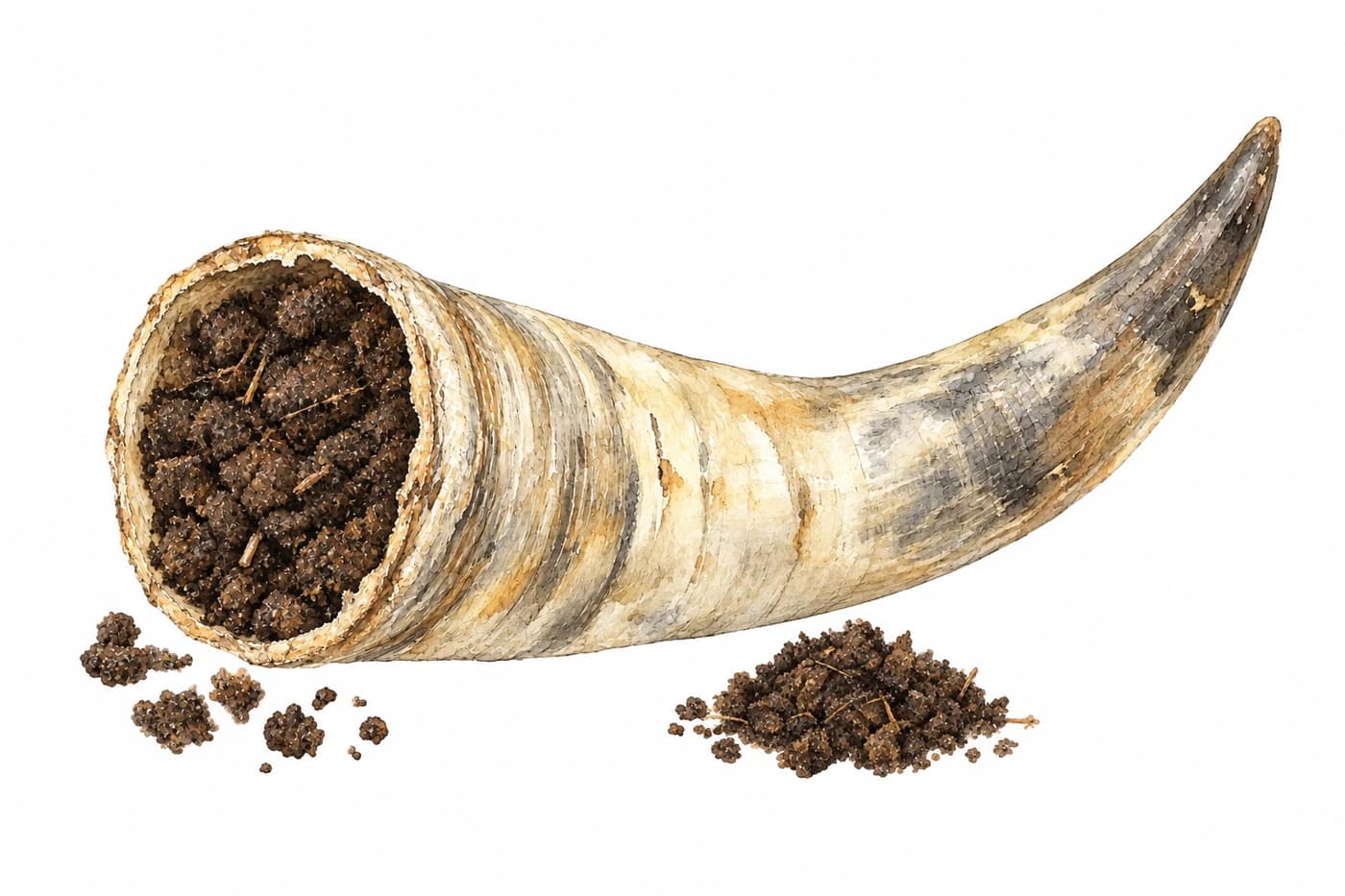 Horn manure 500from €19.69View preparation →
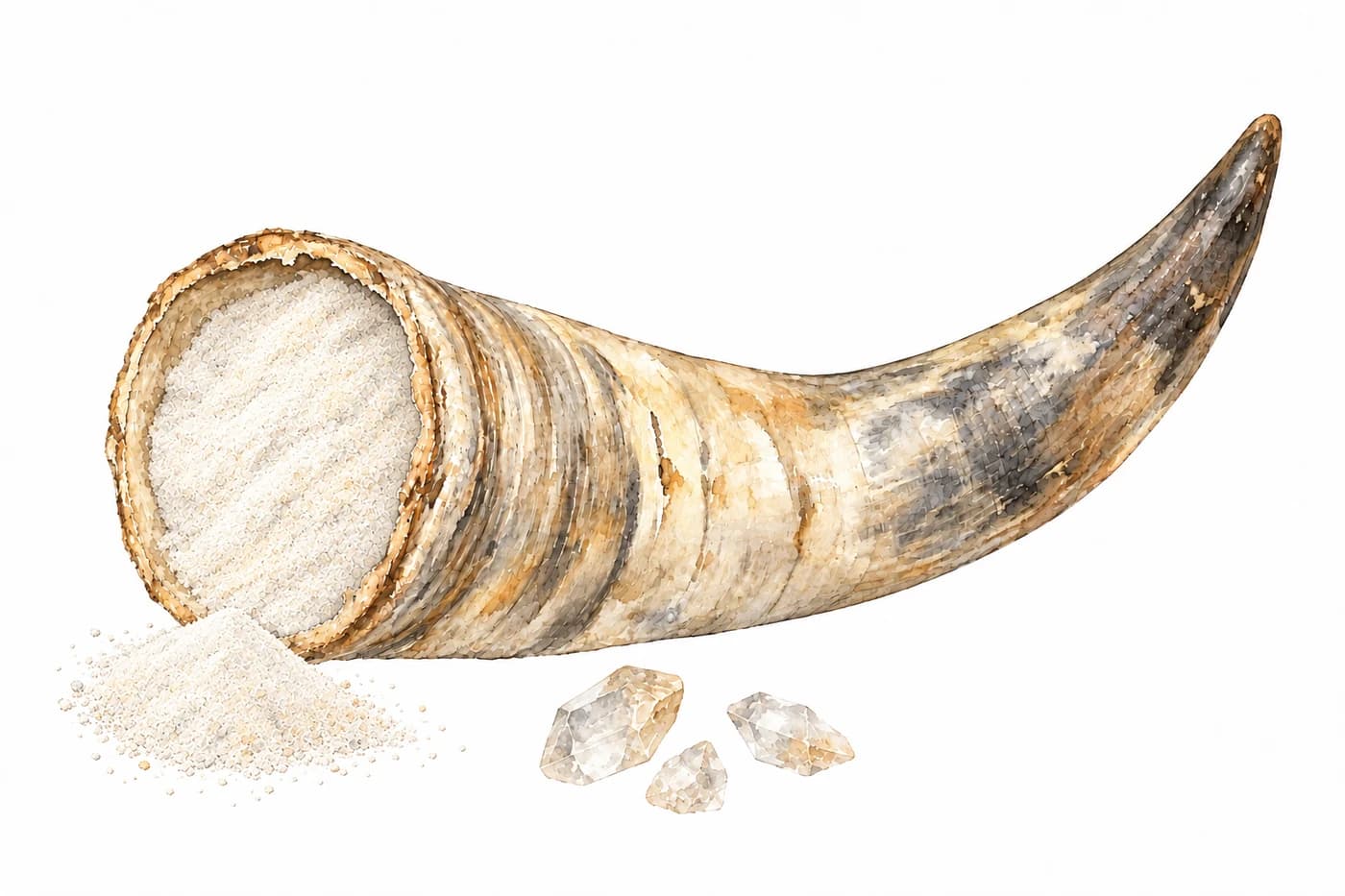 Horn silica 501from €14.19View preparation →
 Horsetail preparation 508from €14.19View preparation →
All biodynamic preparations →How much do I need? Open the preparation calculator →